
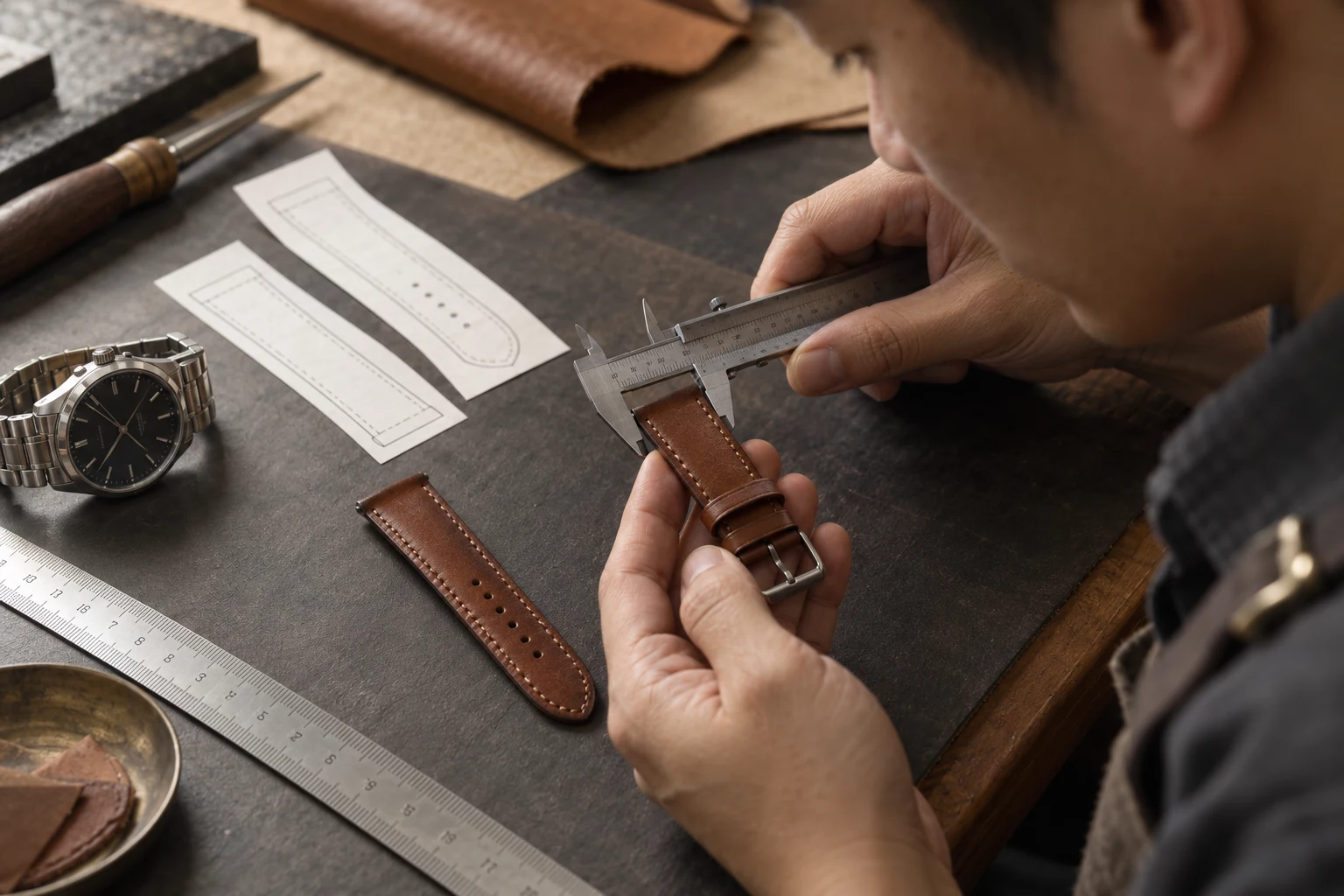
A beautiful strap may press against the watch, pull the dial off-centre or leave an unmanageable tail. Length distribution, attachment dimensions and layer thickness can matter as much as softness. Start with ordinary suitable practice leather before expensive material. Rare leathers need lawful sourcing; species and sourcing status cannot be established from a pattern photograph.
Measure more than total length
Record lug width, buckle-end width, the long and short sections, permitted thickness at the attachment, buckle type and fitting method. Wrist size is one input; case length and buckle construction also occupy space. If copying an old strap, ask what was uncomfortable before reproducing it. Separate hole positions, returns and exposed length.
Paper, then leather
- Use a paper strip to model the wearing path, comfortable fastening point and tail.
- Draw both sections for the actual watch and buckle, distinguishing cut, fold and stitch lines.
- Make an ordinary-leather sample to assess attachment and return thickness.
- Check dial position and whether the keepers hold the tail appropriately.
- Confirm the structure before using final material.
Paper verifies geometry, not durability or final comfort. An experienced person should confirm the attachment; simply fitting into the lugs is insufficient.
Padding and edges must suit the wrist
Thickness near the watch head may differ from that at the wrist's bending area. A hard core or abrupt transition can force an unnatural fold, while bulky returns interfere with the buckle. Smooth edge paint cannot fix unsuitable geometry.
If attractive flat proportions put the watch off-centre when fastened on a model, revisit section lengths and buckle position rather than punching arbitrary extra holes. New holes cannot be undone and can affect spacing and structure.
Function before photographs
Check secure attachment, smooth buckle movement, comfortable edges, normal flexing and tail retention. A fitting trial does not establish connection reliability, and an expensive watch should not carry an unverified experiment. Fine workmanship does not make leather automatically waterproof; explain care and water-exposure limits honestly.
REBIRTH's watch-strap syllabus moves through drawing and patterns, cutting and bonding, shaping, edge work, stitching and finished examples. Retain each pattern and sample version with the reason for changes so discomfort can be traced to a specific decision.
On the paper model, mark fastening, movement allowance and pressure points before making the leather sample. If total length is adequate but holes poorly distributed, adjust the usable fastening area rather than lengthening both ends equally. Match the final design to the actual case and buckle.