
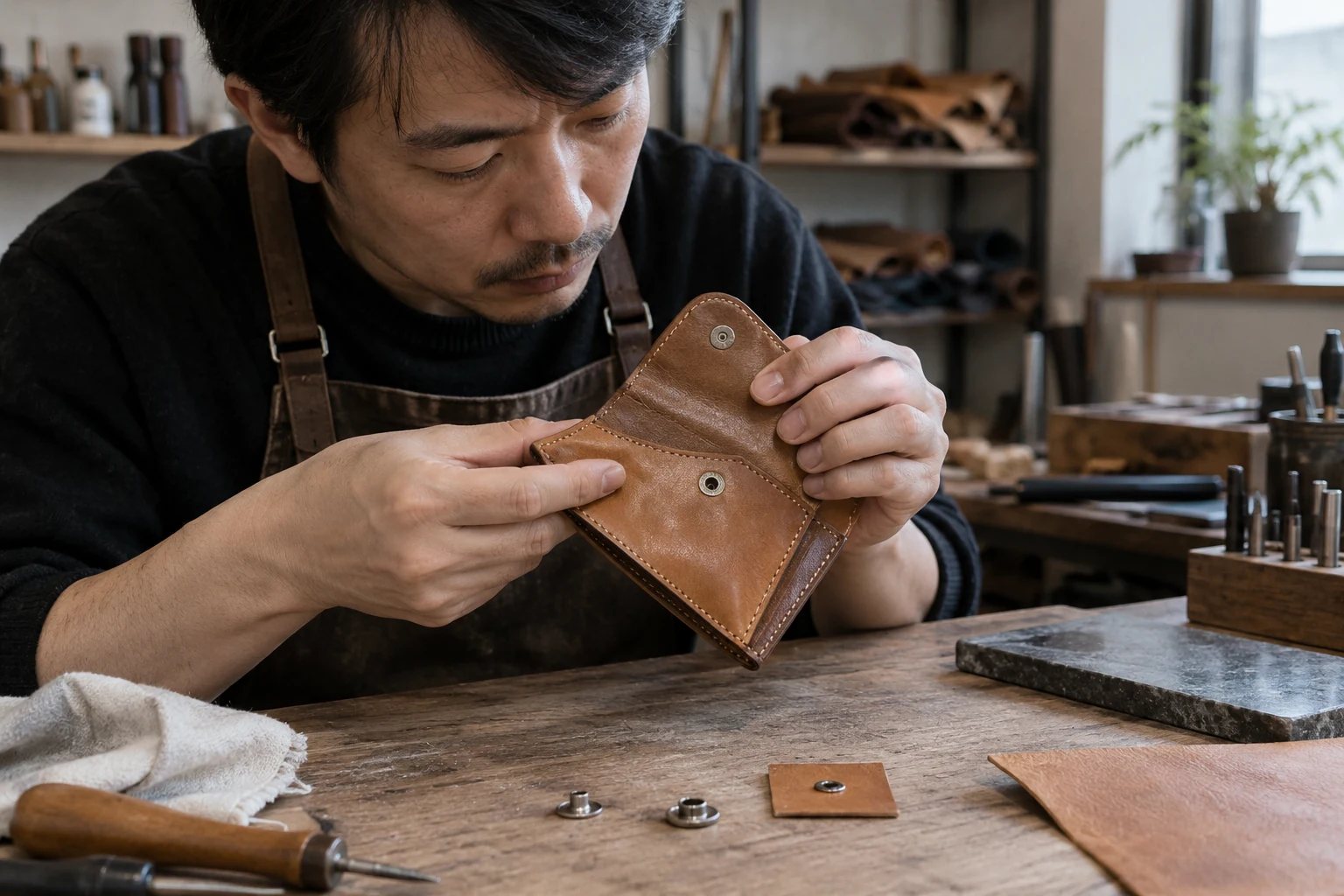
A press stud that will not close or opens too easily may have stretched leather, an enlarged hole or an unsuitable replacement patch beneath it. More pressure can worsen the connection. Assess the stud's mechanical fit separately from its supporting leather.
Watch before dismantling
Empty the wallet and let the flap fall naturally. Check alignment and gently observe whether the problem occurs as the halves approach, at closure or when the support lifts afterwards. Avoid repeated forceful fastening. Photograph front, back and side, particularly the surrounding leather. If inner construction is concealed, plan access and protection before choosing a pressing method.
Three common causes
Worn or distorted halves require component assessment. Weak, torn or stretched leather around the hole needs support assessment. Offset centres require flap-shape and installation checks. These may coexist; a tighter stud does not restore weak leather.
If the stud works but opening pulls the leather into a small tent, increasing resistance may increase the damage. Establish appropriate support and connection before selecting fastening resistance.
Replacement leather: thickness and scope
Thicker is not automatically stronger. Excess thickness can change flap flexing and fitting conditions, while too small a patch may not transfer force into stable material. Review original construction, available connection area, leather condition and fastening requirements on a relevant sample.
Do not use an already stretched hole as the only location reference. Combine flap centre, natural closure and the opposite stud half. Unplanned additional holes introduce weak points and make later correction harder.
Observe what moves during opening
A click is not the whole acceptance test. Check natural closed position, stud stability, lifted surrounding leather and flap distortion during normal use. Avoid strong pulls or rapid repeated cycles as a substitute for assessment.
Record replaced parts, patch scope and retained original areas. Broad ageing may require wider work or explained use limits; repairing one stud does not restore the entire wallet's original strength.
Watch which moves first as the flap lifts: the stud, the leather beneath it or the whole flap. Check the hole area after separation. Lifted support needs attention first; stable support with incompatible halves points towards the component. Keep support, wear and location observations separate.
REBIRTH's Louis Vuitton wallet press-stud leather-replacement case connects with hand stitching and replacement-leather foundations. Focus on location references, supporting area and completed opening checks.