
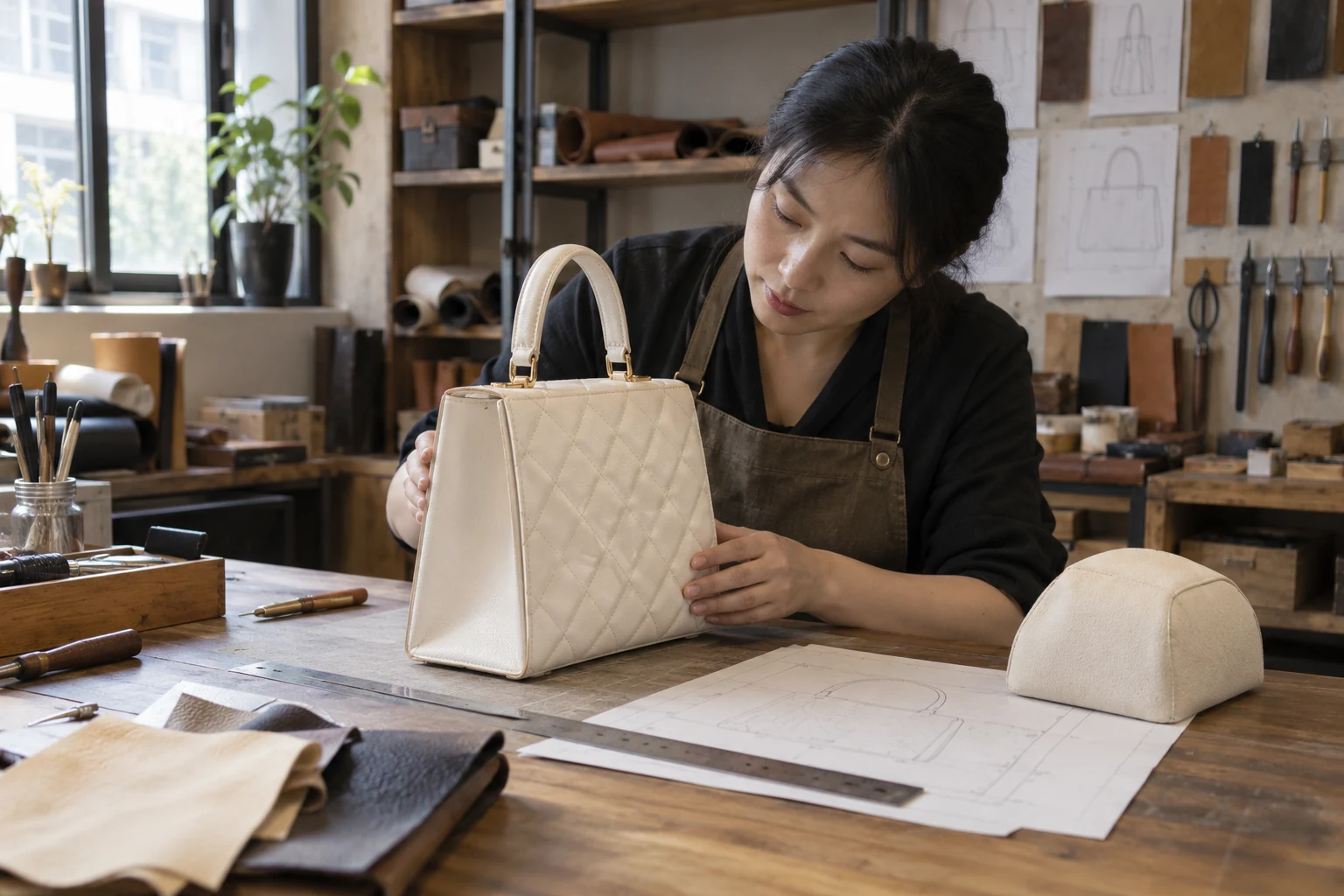
A bag can stand upright when full of support yet lean again when emptied. Structured handbags need a coordinated base, walls and opening, not simply more fullness. Filling may conceal distortion without establishing stability.
Set an empty-bag reference
Place the empty bag on a level surface and photograph normal open and closed states. Check base contact and all four corners before wall lean. Keep the camera level to avoid perspective distortion. Record width, height, side appearance and opening direction without pulling straight. Respect intended design curves rather than forcing every bag into a box; use a reliable model reference where available.
Surface contour or internal support?
Natural quilting, temporary compression and abnormal lining or support are different layers of the problem. If the base leans, forcing a wall upright may transfer stress. A low left opening accompanied by an uneven front-left base corner needs investigation from the base, not extra filling at the top. Failed support or connections may require structural assessment.
Use shaped, gentle support
Support should contact smoothly and distribute force without sharp points pressing on leather or seams. Adjust a small amount and inspect the outside; do not stretch the bag wider than its intended shape. Avoid improvised heat, steam or heavy wetting on unidentified materials.
After every adjustment, inspect front and both sides to ensure one improvement has not created another bulge. Remove support and assess later stability; support is an aid, not the final result.
Include handles and attachments
Lifting changes load compared with resting on a table. Inspect asymmetry, leather and stitches around the handle connections during normal handling, without excessive loads as proof of safety. Record the bag empty, after support removal and during ordinary lifting.
If ongoing shaped storage is needed, specify support locations and how to avoid compression rather than promising permanent freedom from distortion.
Recheck in three levels after each adjustment: base contact, wall direction, then opening and handle connections. If the opening improves but a corner lifts farther from the table, the change is not balanced. Keep photographs without temporary filling.
REBIRTH's Lady Dior reshaping lesson can be reviewed by drawing relationships between base, walls and opening and identifying what each action changes. That reasoning is more reusable than copying the insertion of support.