
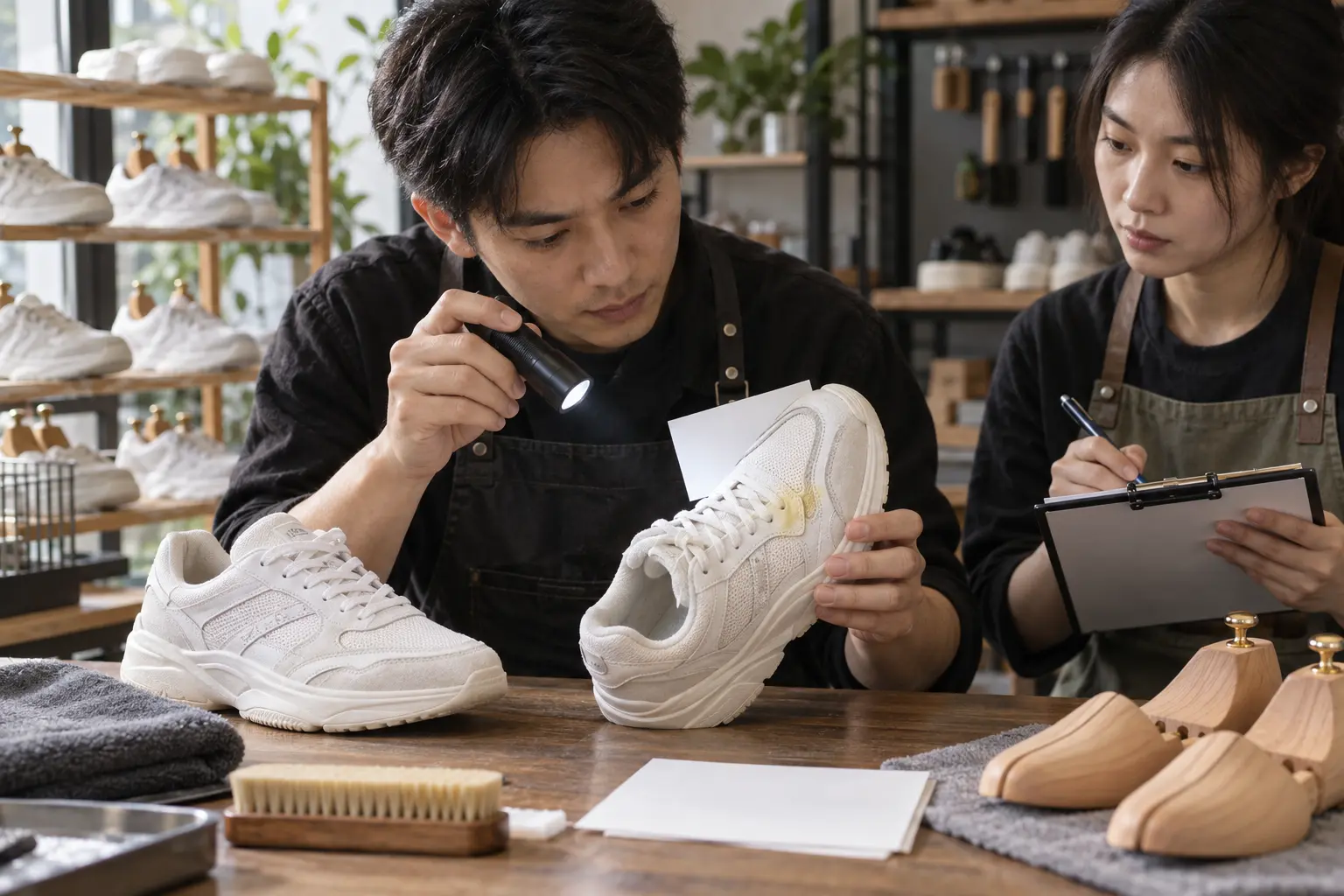
Shoes can look clean when wet yet develop yellow edges, dark tide marks or returning stains as they dry. Moisture can carry soiling and residues from internal layers to evaporation boundaries. Adhesive ageing and material oxidation may also become visible under warm, wet conditions.
Record when and where the change appears, its shape and the drying method. Do not immediately wash the whole shoe again. Assess the upper, lining, midsole, bond edges and internal layers separately before choosing local liquid recovery, further rinsing, adjusted drying or stopping.
Six clues
- Timing: wet, partly dry, fully dry or days later.
- Location: mesh, stitching, toe layers, midsole bond edge, lining or the whole surface.
- Shape: tide line, seam, adhesive edge, original stain boundary or uniform yellowing.
- Cleaners, additives and water quantity used, and how liquid was recovered.
- Drying position, temperature, airflow and use of paper wrapping.
- Shoe age, storage, adhesive condition and previous cleaning.
Common patterns
Soiling migrating back: dark or yellow tide marks around mesh, foam layers or seams, becoming clearer during drying.
Cleaner residue: stiffness, drag, white marks, dust attraction or renewed foaming when locally dampened.
Uneven drying: differences between windward and sheltered areas, or boundaries at filling and paper contact points, sometimes with distortion.
Adhesive or material oxidation: changes concentrated along bond edges, transparent soles or aged areas. These need a separate explanation of likely results and durability.
Investigation sequence
- Stop adding chemicals or heat. Photograph the whole shoe, affected areas, side-lit surfaces and sole construction.
- Check whether all layers are dry. Record moving boundaries while damp, but postpone final judgement.
- Trace concentrations at seams, bonds or layers to possible moisture pathways.
- Review cleaner, amount, liquid recovery and rinsing records.
- Inspect separation, powdering, transparent-sole oxidation and heat-bonded films that cannot be treated like ordinary fabric.
- Test a small relevant area instead of repeating the whole-shoe procedure.
- Compare after complete drying and check for recurrence.
More water may move additional contamination out of internal layers. Residue accumulates without targeted recovery, while water, heat and friction do not turn aged adhesive or oxidation into ordinary dirt.
Workshop prevention
- Map mesh, leather, suede, prints, heat-bonded films and bond edges before cleaning.
- Remove loose dust dry and address heavily soiled areas first.
- Control foam and moisture; collect dirty liquid promptly with clean absorbent materials.
- Separate tools by light and dark colours and by material.
- Support the shoe's natural shape and encourage even drying.
- Check partly dry and fully dry; never hand over a wet shoe.
- Record recurring locations and use that evidence to adjust future methods.
Stop repeated washing if the midsole separates or powders, colour migrates, leather or suede hardens, prints or films lift, the shoe distorts, unusual odour persists or yellowing centres on aged adhesive. Reassess the material or structure.
Does paper wrapping always prevent yellowing? No. The paper, contact edges, residues and internal soiling can introduce new problems.
Can a strong oxidiser be used on white shoes? Not without material assessment. It can affect adhesive, prints, leather, stitching and flexibility, and may not resolve ageing.
Inspect colour and structure while wet, migration boundaries while partly dry, and yellowing, feel, shape and bond stability when fully dry. Demanding orders may also need a next-day check.