
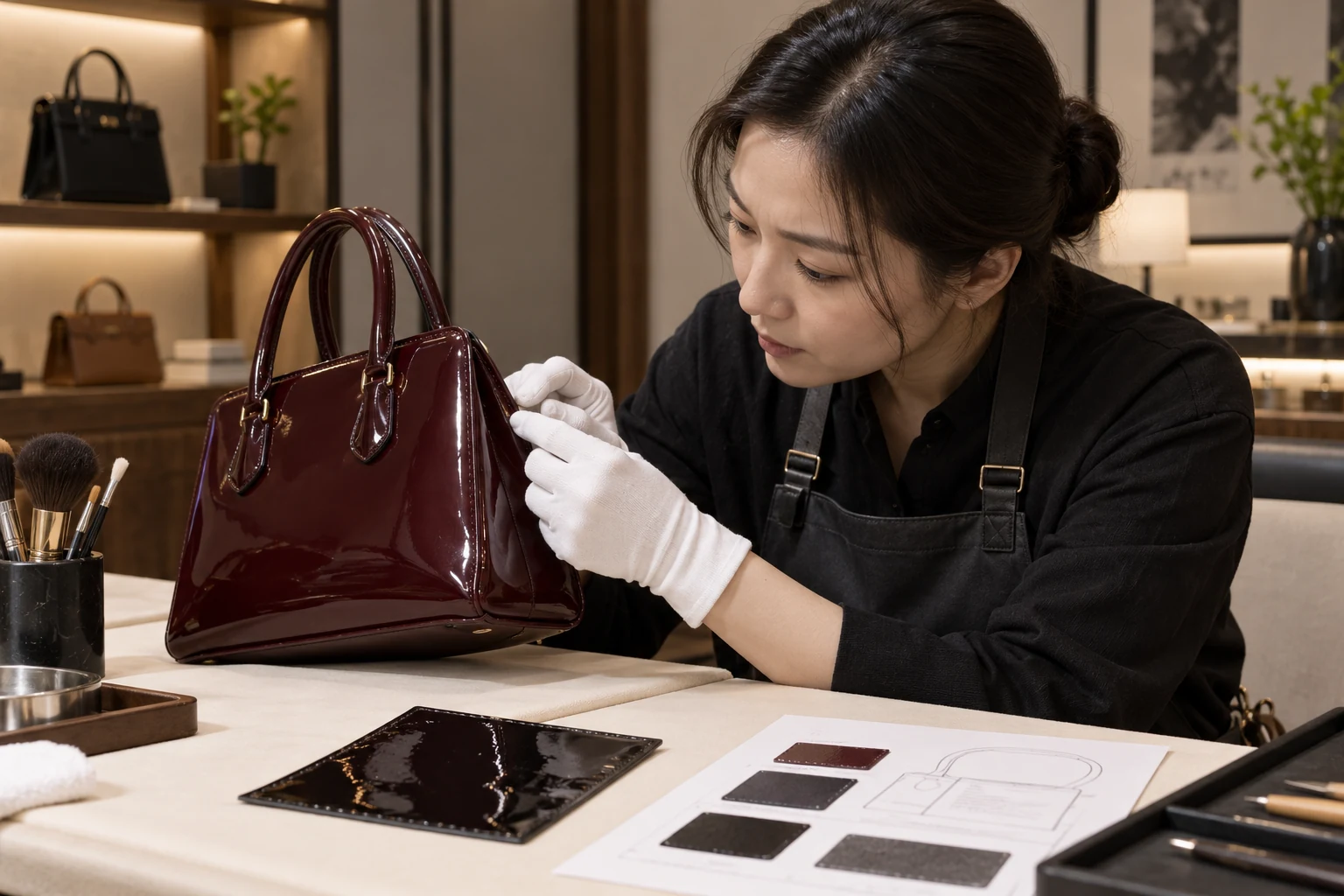
Dark colour does not erase an item's history. Cracks, delamination, distortion, stitching and old colour in edges may remain or become more obvious. A light-to-dark change may look straightforward on the broad surface while creating complex boundaries across the whole bag.
Map five groups of parts
Record main leather panels, stitching, edge paint, lining and hardware connections. For each, state whether colour will change, whether it is accessible, whether disassembly is needed and whether neighbouring material could be contaminated. Include hidden-in-photographs areas such as flap undersides, handle returns, zip ends and strap-hole edges. If the inside will remain unchanged, agree that scope before work.
Three decisions before sampling
Is the original surface stable? Persistent tackiness, brittleness or unknown thick coatings cannot simply be covered darker. Is a change in character acceptable? Translucency, two-tone effects and natural patina may not survive opaque recolouring. Is the structure sound? Colour cannot restore load-bearing strength to split handles or damaged attachment tabs.
For example, a red practice bag may accept exterior recolouring while red thread and folded inner edges remain visible. Exterior adjustment can be an agreed scope; an entirely black interior, thread and exterior with unchanged feel must be assessed rather than assumed achievable.
Test the complete system
On suitable practice material, verify preparation, coverage and topcoat, then cure as instructed. One stroke of black proves little. Check old colour showing through or migrating, abnormal flexing, sticking, final feel and gloss. Include a stitched or folded sample to test masking and boundaries. A flat panel does not establish success in narrow gaps and soft folds. Patent leather requires a separate assessment route.
Explain the scope concretely
A useful explanation is: the proposed work changes the exterior leather while retaining the lining; visible thread and inner folds will be agreed using a sample and scope map; colour wear is included while structural splits require separate assessment; the new finish will have its own use and care requirements.
This tells the customer what changes, what remains and what needs another decision. Keep the colour-change record for resale and never describe the altered finish as untreated original colour.
Practise boundaries before coverage
Map the five groups and ten easily missed locations on your own worn-out bag without treating it, then ask someone to check. REBIRTH's rose-red lambskin to black, patent leather to black and original-colour restoration cases are useful for comparing routes, not proving that every pale bag can be made black in the same way.
Use rows for outer leather, folds, stitching, zip tape and hardware surrounds. Record current condition, goal, sample result and unresolved questions. Keep unclear rows pending before making an irreversible colour change.
Explore original-colour restoration and colour-change lessons