
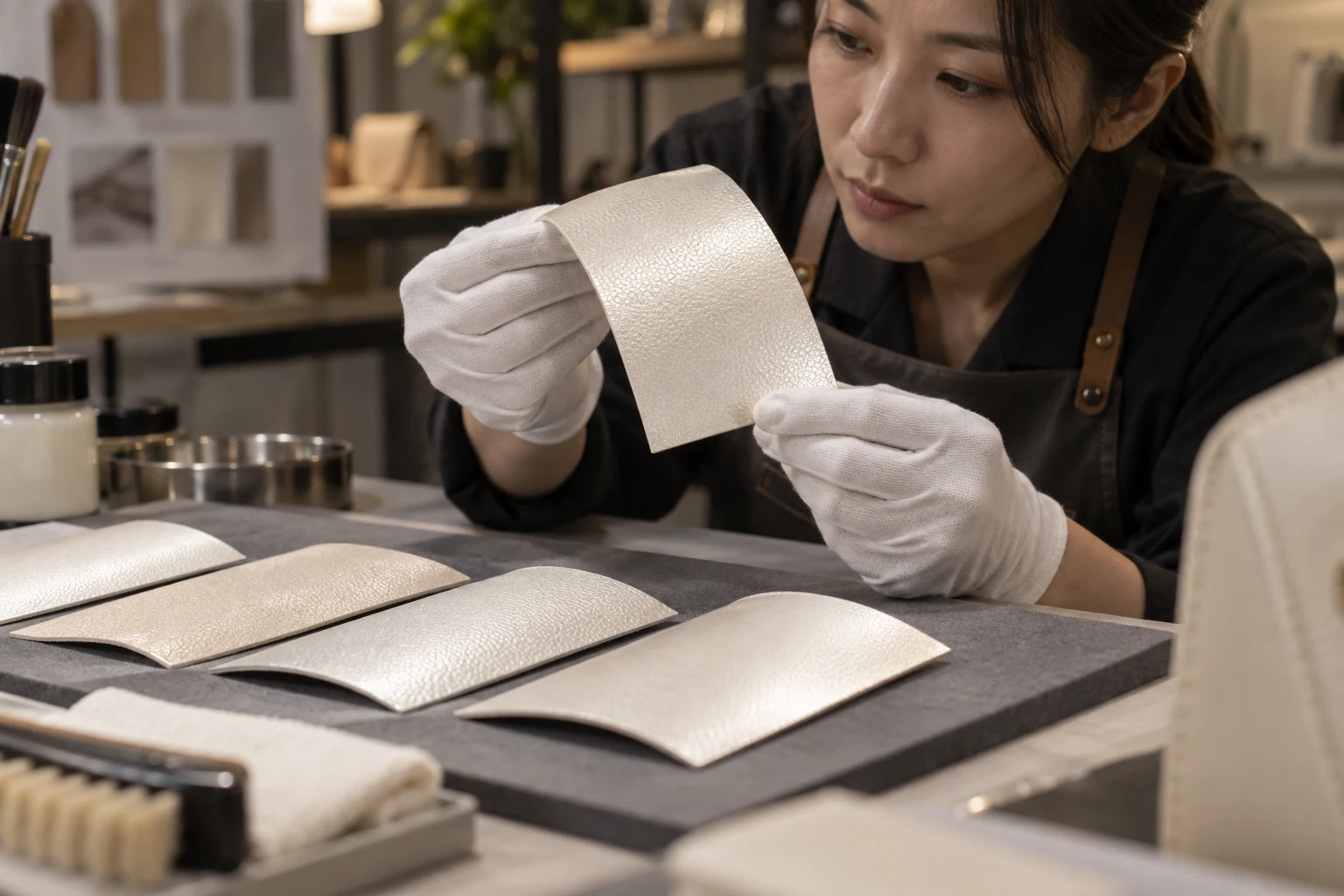
A pale pearlescent repair may match head-on yet become a bright patch from the side. Adding white changes the frontal colour without fixing the reflection. The target changes with viewing angle; it is not one static colour.
Pearlescent and metallic finishes are more than shiny solid colours. Observe base colour, effect layer and surface gloss separately. A single photograph cannot identify the exact effect material or layer structure.
Document the change
Keep the item and light fixed while recording front and oblique views from both sides. Move slowly between angles and note whether the defect is constant or brightens only at one angle. Include repaired and reference areas in the same frame. Photographs describe the problem but cannot provide a reliable screen-based formula. For unknown previous restoration, establish whether the current effect is original or an added coating first.
Create a multi-angle sample card
Use similar scrap leather and an assessed compatible system. Record each sample's base colour, effect product and surface treatment, photographing it at the same angles. Change one factor per sample: establish the base colour first, effect strength and uniformity next, and gloss last. Repeatedly adding brightness or thickness can destroy translucency without correcting angle-dependent differences.
Why local transitions are difficult
The edge can differ in effect density and reflection as well as colour. A sample that blends head-on may show a pale ring obliquely. Check overlapping layers and effect distribution before darkening the mix; a darker colour does not automatically remove the ring.
If controlled sampling cannot meet the agreed result, explain the visible limit and discuss acceptance, a revised scope or leaving the item unchanged. Wider treatment is not the default, and an invisible result at every angle should not be promised.
A useful learning exercise
Keep an intact reference and describe its appearance from three angles. Ask a colleague to identify sample differences without seeing the recipe. Clarify whether the problem is frontal hue, excessive brightness at the side or overall topcoat gloss. Keep an acceptable sample and two representative failures so the next item is assessed by the type of mismatch rather than last time's proportions.
REBIRTH's pearlescent-bag colour restoration and plated-effect leather lessons introduce different approaches to special finishes. Their presence in the syllabus does not mean all shiny leathers share one treatment. An unidentified system needs physical assessment and professional guidance.
Record front, left-tilted and right-tilted views with fixed light and position. If lightness reverses at an angle, record an angular mismatch. Do not select only the most flattering image or average away a problem visible from one direction.