
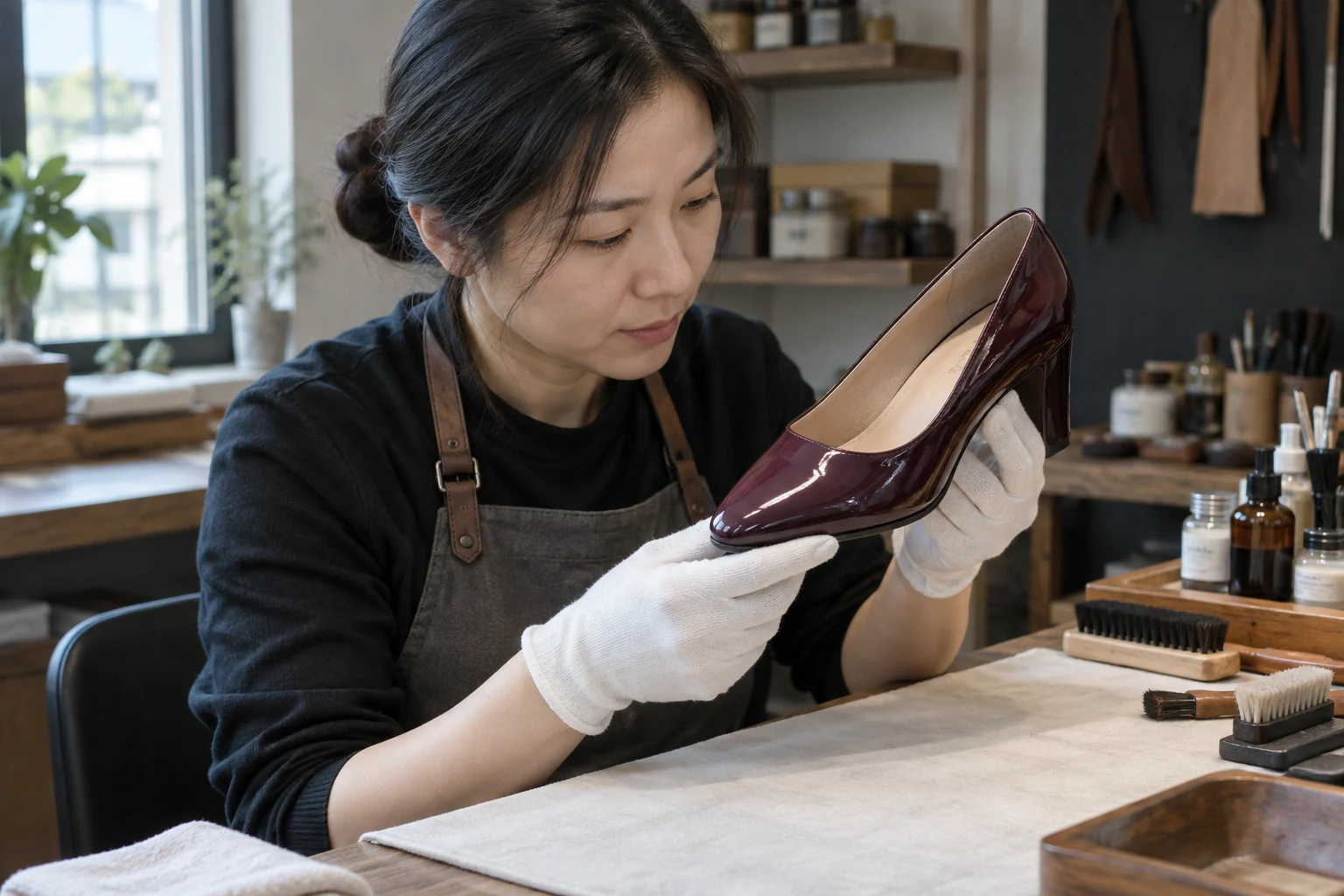
Patent shoes or bags can remain the same colour yet look hazy, dull or uneven because reflection is discontinuous. Original-colour restoration needs both base-colour and surface assessment and is a different goal from changing colour.
Make reflection checks repeatable
Use a soft light source with a clear shape and rotate the viewing angle slowly. Compare whether the reflected line is obscured by dust, scattered locally or bent by unevenness. Keep the object position fixed for photographs and avoid flash glare that erases detail.
Reflection supplies clues, not a complete diagnosis. Check tackiness, cracks, blisters, colour migration and previous work. An unstable original layer needs assessment before further attempts to brighten it.
Separate colour and gloss
Even colour with local dullness points towards the surface; continuous gloss with changed underlying colour points towards a colour issue. Where both occur, reconsider the sequence. A thicker glossy layer cannot conceal every base problem.
On a burgundy patent shoe, scattered reflection at the toe but clear reflection at the side is not solved merely by mixing burgundy. State whether the target is tone, scratch appearance or reflection so the sample can be evaluated.
Dry samples and flexing locations
Use a compatible system on a relevant sample and compare only after stability, not at its wet-gloss stage. New tackiness, uneven shrinkage or boundaries need compatibility and process investigation before further layers.
A shoe toe, walking crease and bag flap have different flexing conditions. A smooth stationary surface does not establish its appearance in normal use.
Agree achievable limits
Keeping the original colour does not make every injury fully reversible. Deep or unstable damage may require a discussion of local improvement, broader work or leaving it unchanged. Do not expand over stable areas just for an even photograph.
Record frontal colour, oblique reflection, edges and folds under matching conditions, including remaining differences. Give defects descriptive names: a scattered line at the toe, a sharply bounded bright patch, or reflection bending across a depression. This is more useful for later comparison than old or dull.
Check colour against adjacent areas when stably dry, reflection continuity under the same shaped light, and shoe or flap flex points separately. REBIRTH's original-colour patent-shoe and practical patent-restoration lessons can be compared by base colour, surface and use conditions rather than copied as one wiping action.