
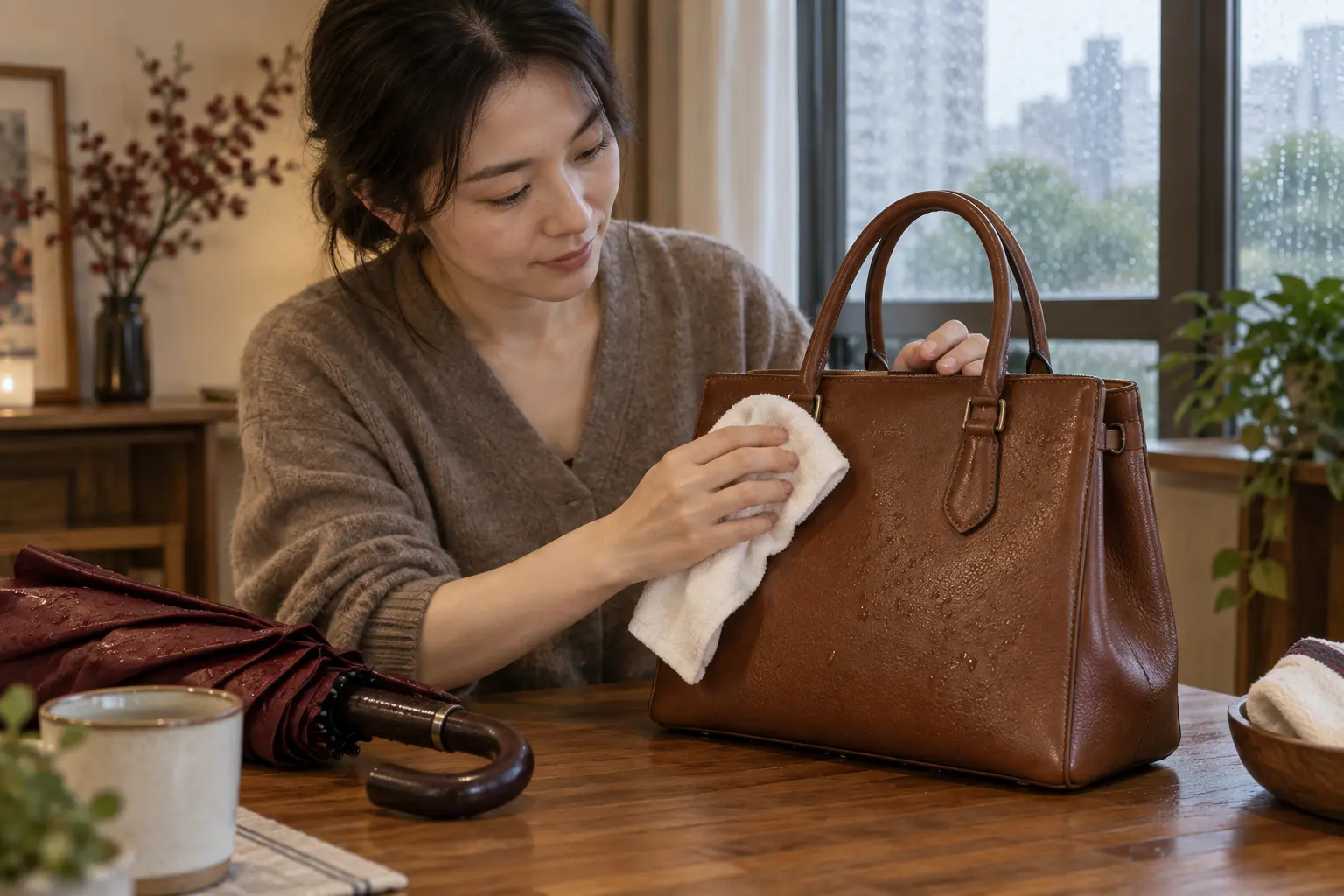
Water can travel through leather fibres, stitching holes, edge paint and internal layers. Rubbing, heat or conditioner applied too soon can make the damage worse.
The first 30 minutes
- Wash and dry your hands and remove jewellery. Photograph the front, back, base, sides and wet areas. Note how long the bag was exposed and whether water entered it.
- Blot vertically with white cotton or unprinted absorbent tissue, changing to a clean surface frequently. Do not rub.
- Empty the bag and open zips. Support its natural shape loosely with acid-free or plain white paper; do not stretch it.
- Place a dry towel underneath, avoiding direct contact with wood, newspaper or dyed fabric.
- Leave it in a shaded, ventilated place, away from direct airflow. Check and replace damp filling every one to two hours.
Do not use a hairdryer, direct sunlight or conditioner while the bag is wet. Record the material: smooth leather, vegetable-tanned leather, suede, patent leather, coated canvas or mixed textiles. Note colour on the white paper, softened edges or adhesive, and changes around hardware.
During the next 24 hours
Even darkening or slight dampness, without tackiness, shape change or colour transfer, calls for continued observation. Expanding tide marks, colour transfer, blistering, tackiness, matted suede, cracked edge paint or collapse are reasons to stop handling and seek professional assessment.
Check again when fully dry
The lining, seams, internal layers and filling must all be dry, with colour stable for several hours. Compare watermarks, colour, feel, gloss, shape, odour and areas around hardware in diffuse daylight. Only consider a product test when the material is identified and stable and there is no colour transfer.
Heat and sunlight encourage uneven drying and migration. Wet rubbing can enlarge marks; alcohol wipes and disinfectants may damage finishes. Applying oils while wet can trap moisture and soiling.
Common questions
Can I seal the damp bag with desiccant? No. Desiccant may help later during storage, kept away from direct contact, but does not replace ventilation.
Should I re-wet a dry ring mark? Have the material and mark assessed first, using photographs. Do not expand the wet area experimentally.
When can I use the bag again? When every layer is dry, odour is absent and the condition is stable. Thick internal layers can take longer than the surface.
Keep a record of exposure, material, blotting, filling changes, drying conditions and checks at 24 hours and after drying. Include overall, close-up and side-lit photographs.