
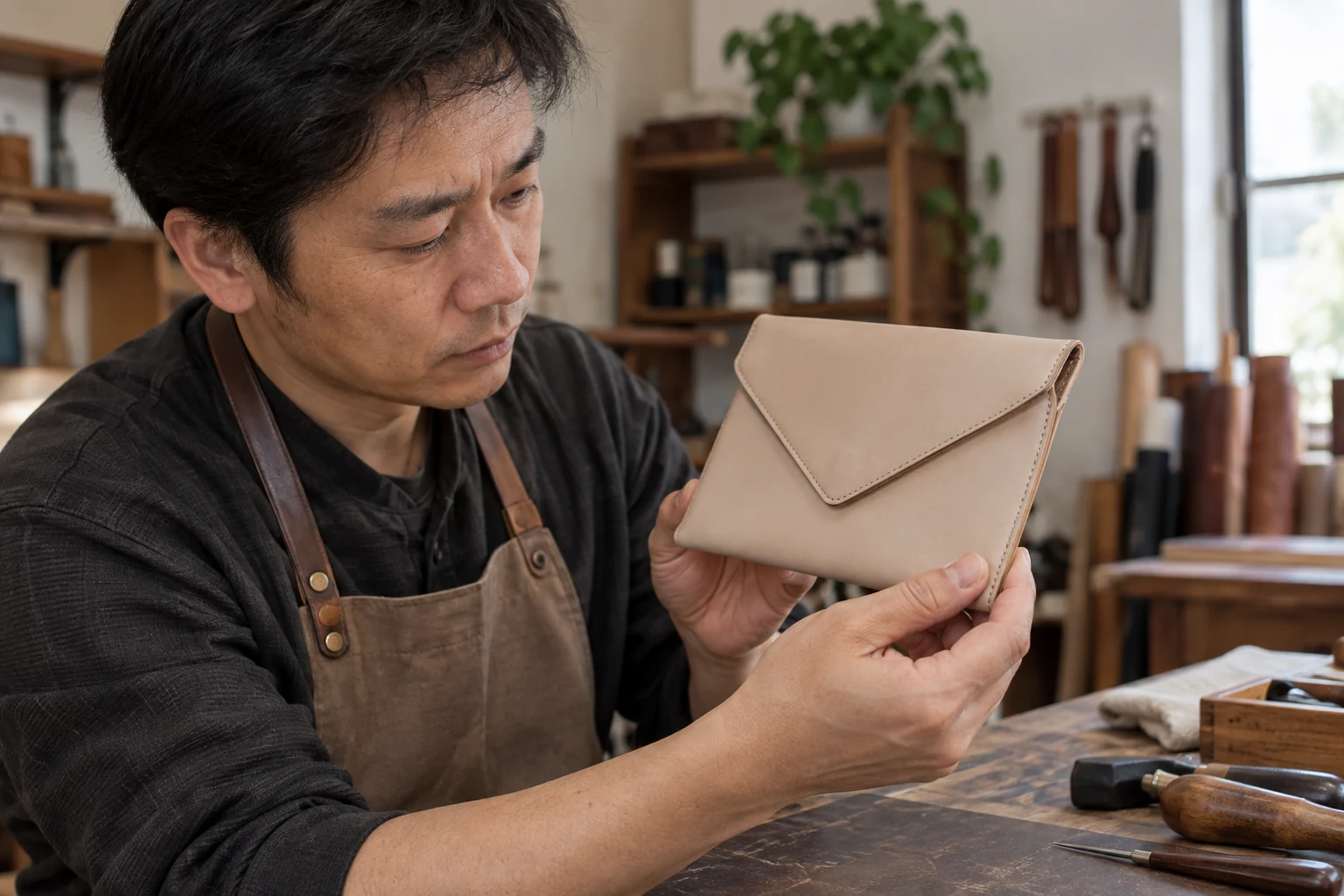
An envelope flap's point is small but visually prominent. Slight changes in colour or thickness interrupt its clean outline. Covering a pale wear spot is only one part of the task.
Inspect its natural position
Close the flap normally and check whether the point leans, edge lines remain continuous or the fastening pulls it out of place. Open it to inspect the reverse and folded edges, distinguishing wear, missing material and distortion. Do not pull the point into an ideal shape for a photograph.
Keep an overall frontal view, a point close-up and a side profile: these show proportion, damage and thickness. Close-ups alone make it easy to lose track of the original overall line.
Colour loss or shape loss?
An intact outline with surface colour loss may need local colour harmony. Missing covering or edge requires an assessment of material replacement and structure. Curling or separated layers need their own response rather than being fixed temporarily by a thick coating.
A beige point worn pale but still sharp can become blunt if material builds up. Conversely, colour alone cannot remove a physical notch.
Include the transition in sampling
Confirm dry tone and gloss on a compatible sample, then plan the actual junction. Two nearby folded edges reflect differently from the flap plane; compare more than the brightest angle. Follow the original structure rather than leaving a round patch on an intact panel.
Pause if the point becomes heavy, folds lose definition or stitches are covered. Small work still needs staged checks and can reveal tiny errors particularly clearly.
Close the flap again
Check the normal closed outline and whether the tip rubs hardware, the body or added material during opening. Inspect how the two edge lines meet and whether the reverse has excess build-up. Use normal movement, not forced bending.
Repeat the original three photographs and record the exact work area. Explain any original structural issue outside local scope rather than treating colour coverage as a complete solution.
Follow the left edge, right edge and their meeting point. A rounded tip with otherwise smooth edges suggests excess local volume; an intact point with one shiny edge suggests that side's surface transition. Repeat with the flap closed because reverse build-up may alter the front only then.
REBIRTH's Hermès envelope-bag colour case can be paired with matching, filling and edge work. Track contour, transition scope and final closure so the reasoning transfers to other envelope designs.