
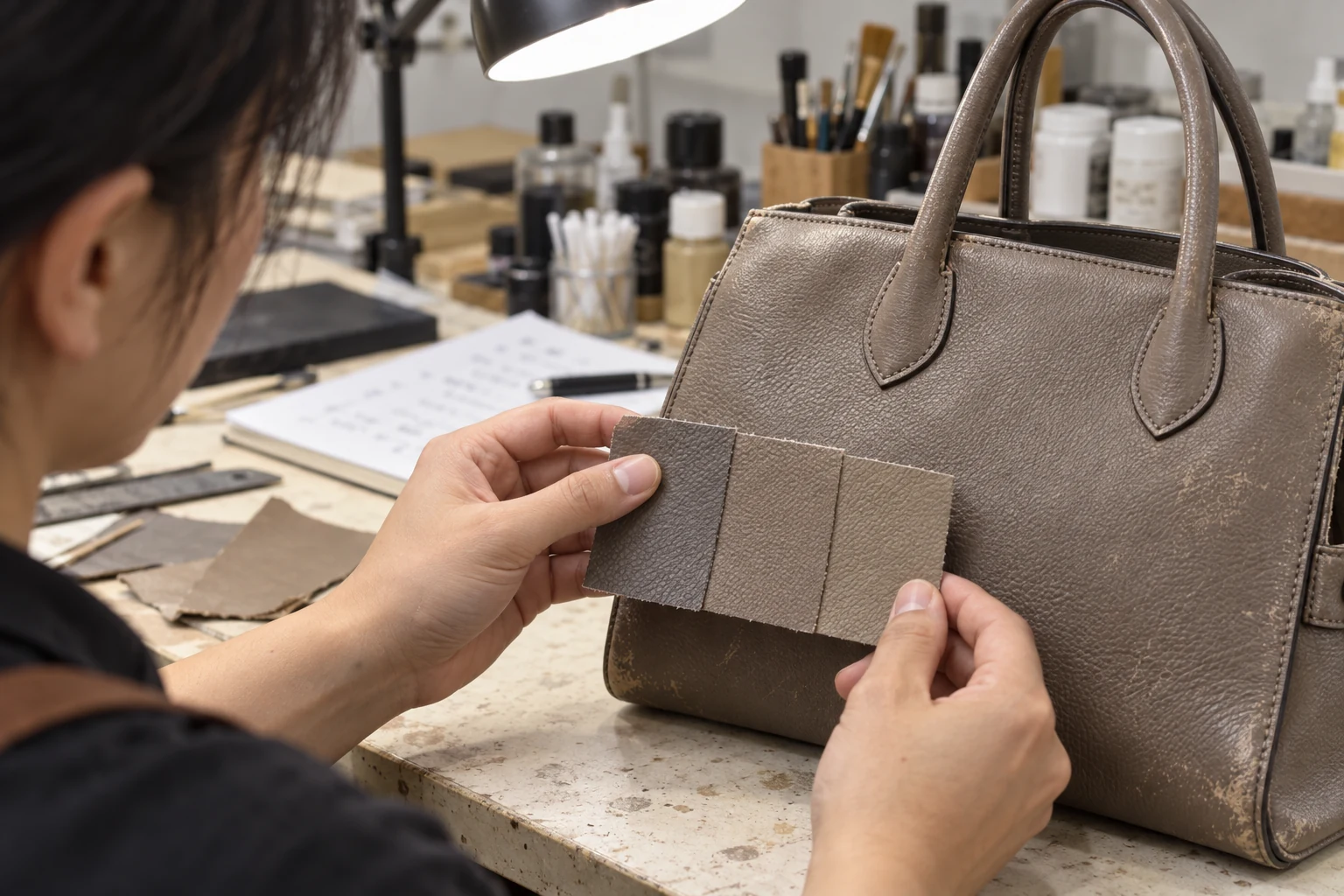
A mix looks right in the cup but grey on the leather; adding yellow then makes it muddy. The problem may be inconsistent comparisons: wet pigment against dry leather, a thick sample against a thin finished coat, or warm lighting against daylight. These exercises concern stable finished leather suitable for recolouring, not aniline, oil-waxed, patent or precious leathers.
Choose the reference first
An old bag may have darkened handling areas, faded exposed areas and a protected area closer to its original colour. Each is real, but each implies a different repair goal. For a local corner repair, normally reference a nearby stable area. Agree an overall colour target before treating the whole bag; do not silently change it to match a concealed area.
Photograph the defect, transition and reference together and mark the reference on the job sheet. Photographs document the target but cannot replace physical matching because screens, white balance and lighting alter appearance.
Five steps for reliable samples
- Choose practice leather with similar absorbency and finish. Paper tests can indicate a broad direction but are not final confirmation.
- Prepare the base according to the chosen system so its colour and coverage resemble the intended work. The same thin colour layer looks different over light and dark bases.
- Retain the base mix and adjust small portions, changing one direction at a time: red, yellow, lightness or greyness.
- Record actual quantities and products. If the scale cannot measure tiny additions reliably, increase the trial batch size. Unequal drops are not precise reproducible ratios.
- Dry as instructed and compare the sample beside the target. Where a topcoat is part of the system, assess the complete system as well as the colour coat.
Keep the unsuccessful samples
On a grey-beige practice bag, one sample may be too red, another close in colour but too shiny, and a third grey after drying. Label these separately as hue, gloss and dry-result problems. Reconsider the mix for excess red; investigate gloss before adding black to a shiny sample; check base colour, coverage and added colours for greyness. Different pigments and systems do not share a universal correction formula.
When to stop chasing colour
A match that changes markedly between two everyday light sources may reflect the lighting and pigment combination. Keep the sample for instructor review instead of repeatedly covering the item. Colour transfer, tackiness or an unstable base must be resolved before matching: accurate colour cannot compensate for poor adhesion. Pearlescent, metallic and two-tone finishes also require angle and layer assessment.
Repeatable skill means a colleague can use your target, products, quantities, layer sequence, drying conditions and sample to approach the same result, and you can repeat it the next day while distinguishing colour, gloss and texture differences.
Connect REBIRTH's practical colour-matching lessons with smooth-leather cleaning, filling and recolouring. Review how the reference is chosen, when additions stop and how the full finish is assessed. Label samples A, B and C: base mix, one hue adjustment and one lightness adjustment. State which have topcoats and compare equal drying states before rejecting a recipe.