
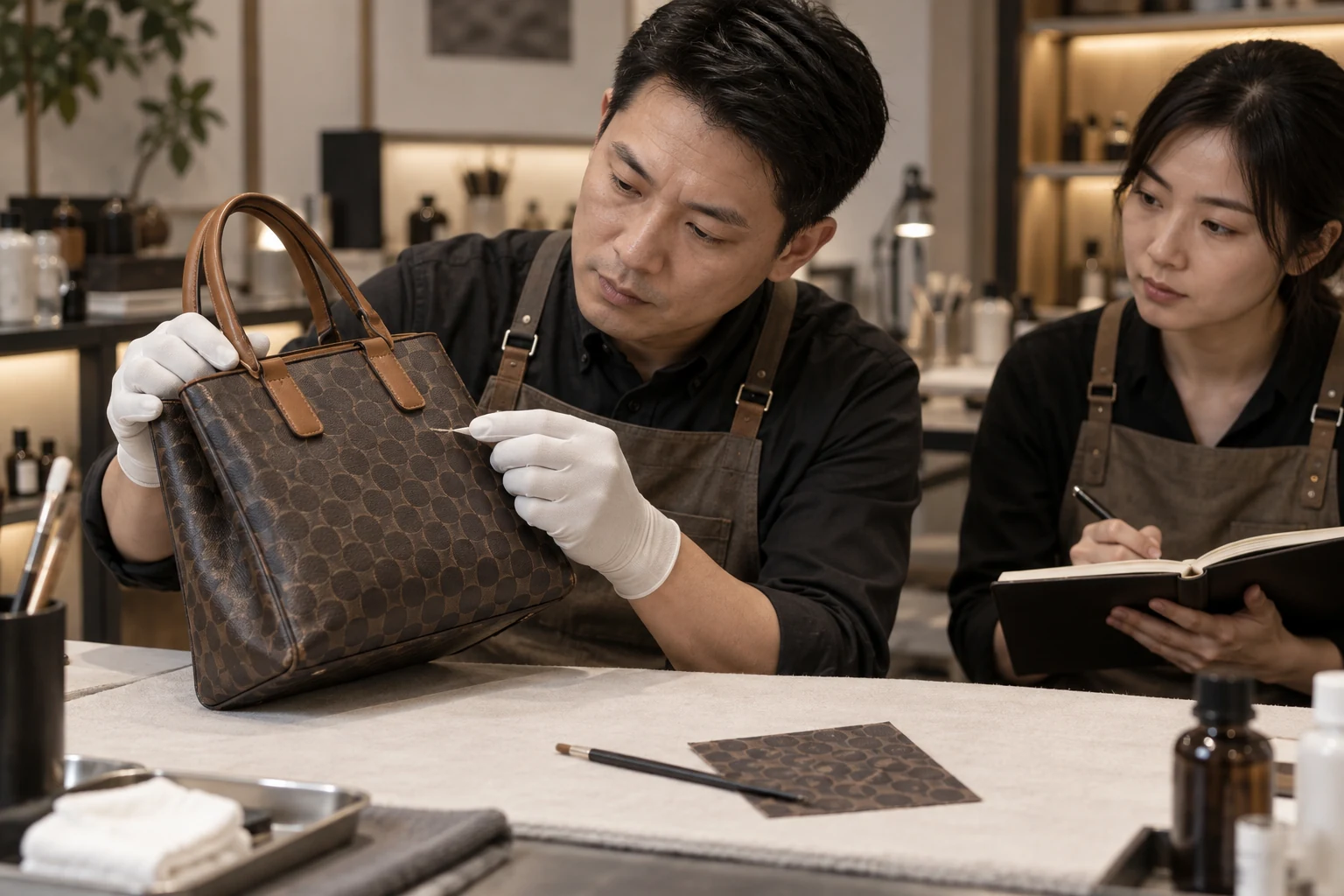
A small missing motif may look easy to redraw, yet the repair can have hard edges, overly fresh colour or buried texture. If the base keeps peeling, accurate drawing solves little. These observations concern maintaining an existing item, not reproducing branding, making counterfeits or hiding repair history. Identify material from the item and reliable information rather than assumptions about a brand.
Three damage levels
Pattern wear over a stable base differs from loss of both pattern and surface, or extensive brittleness, peeling and delamination. Drawing alone cannot resolve the latter conditions. Check lifted edges, extending cracks and tackiness under normal and side light. Do not pull at a customer's surface to test adhesion; seek experienced assessment when stability is unclear.
Three references
Use an adjacent comparable motif on the actual item for colour and ageing, continuous lines for position, and the surface for texture and gloss. Internet images may show another year, scale or lighting and are not exact references.
A line can be accurate in shape but look newly printed. Compare saturation, edge sharpness and gloss rather than simply lightening the colour.
Three sample exercises
Practise consistent fine lines, short joins without raised overlaps, and then the complete colour and topcoat system on compatible samples. Use materials and tools appropriate to the taught repair system, not ordinary art paint. Focus on line, colour or gloss one at a time. Wait for the required dry or cured condition before judging the result.
Agree a visible limit
Used patterns naturally vary and a local repair may remain identifiable from some angles. Agree scope, boundaries and retained marks beforehand. Disclose restoration on resale items even if photographs conceal it. Continuing base ageing may limit durability despite an improved decorative surface.
REBIRTH's coated-canvas pattern, film-failure and combined surface-and-pattern lessons show how damage depth changes the route. Track what the instructor resolves before drawing. Transferable skill means knowing whether a new item is suitable, where to reference and when to stop; complex ageing or unknown layers still need physical review.
Practise on an unbranded pattern with line widths, spacing and turns marked. Establish position before colour and transitions. Inspect at normal viewing distance as well as close up. Do not change an original into a different pattern merely to make it more regular.