
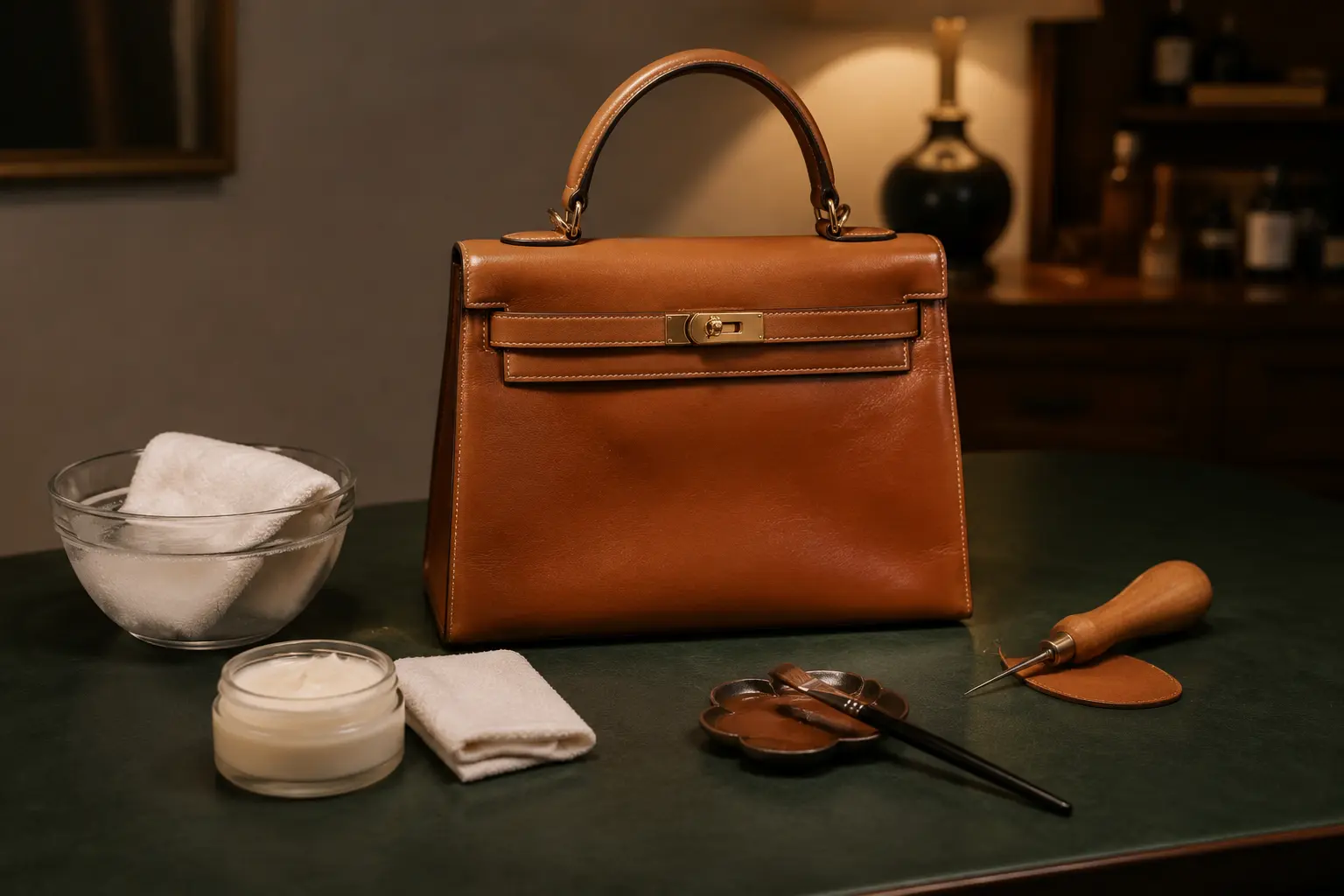
Many treatment errors start with the wrong objective: trying to clean away wear, using conditioner to disguise colour loss, or recolouring before the surface has stabilised.
Set the objective and the limits
Cleaning deals with soiling. Conditioning supports the condition of suitable leather. Recolouring addresses missing colour. Repair deals with more complex surface or structural damage.
If colour is already coming off or the finish is unstable, repeated wiping can enlarge the damage. Applying colour over a dirty surface can seal the soiling beneath it. Conditioning or recolouring too soon after cleaning can also make the condition harder to assess and affect adhesion.
Understand the four processes
- Cleaning: remove dust, grease or surface stains that can safely be removed. Check that soiling has decreased without unwanted changes in colour, sheen or feel.
- Conditioning: improve dryness, suppleness and everyday condition where appropriate for the leather. Conditioning is not polishing and cannot replace colour lost through wear.
- Recolouring: address worn colour, local colour differences or restoration needs. A close colour match is only one requirement; adhesion, coating build, feel and durability also matter.
- Repair: address damage to edge paint, construction, coatings, scratches or cracks. More complex repairs often need several stages and tighter control of risk.
A practical sequence
- Identify the material and its present condition.
- Distinguish soiling, dryness, colour loss and structural damage.
- Test the proposed product in an inconspicuous area.
- Begin with reversible, lower-risk steps.
- Let each stage stabilise before deciding whether another type of treatment is needed.
Assess the whole result
A cleaner appearance, more shine or covered colour loss tells only part of the story. Also check colour uniformity, tackiness, changes in feel, obscured grain and stability over time.