
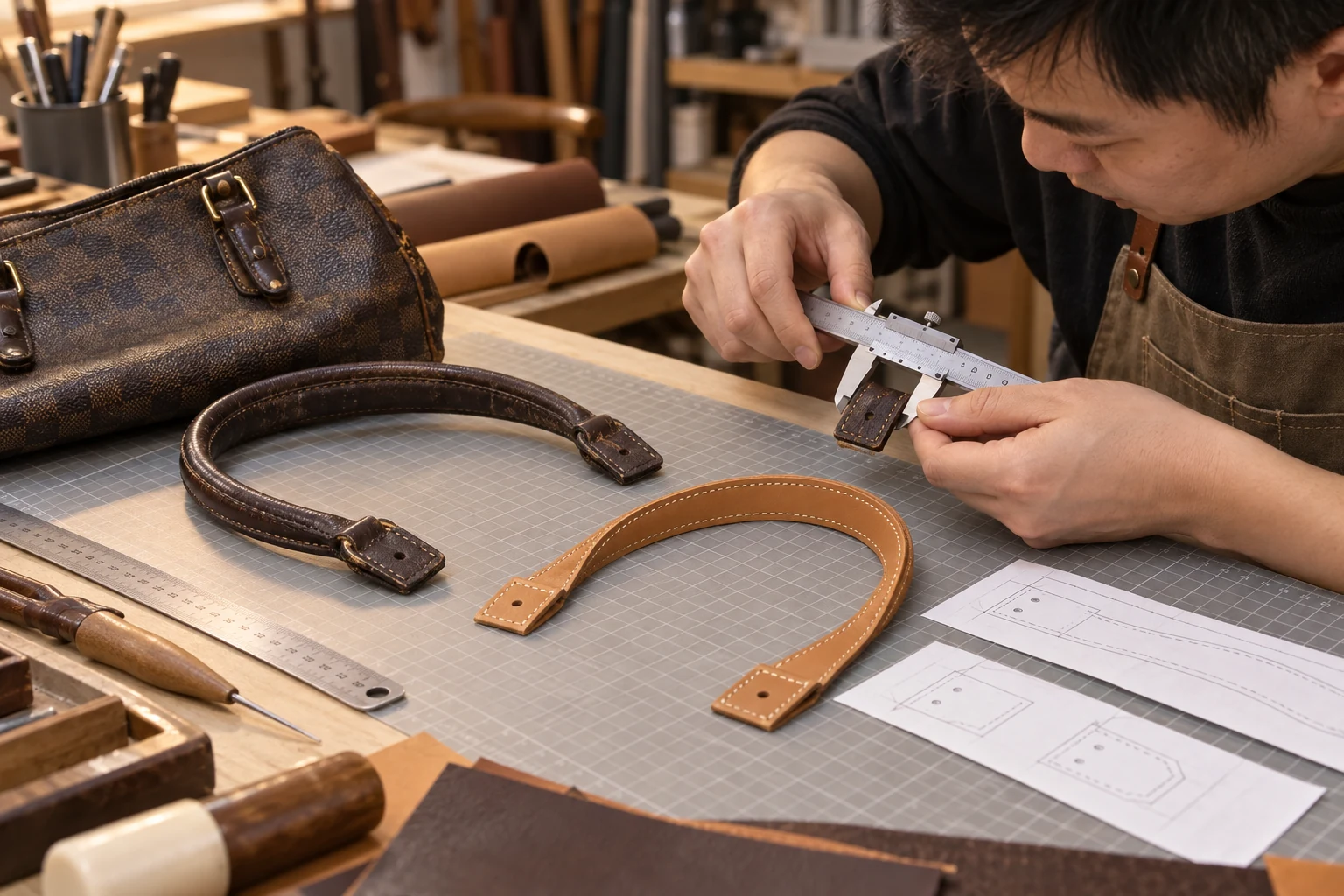
A new handle can match in colour and stitching yet sit unevenly, leave too little hand clearance or distort the opening. Replacement rebuilds the connection between hand and bag, not just an outline. Record it before disassembly and practise first on your own worn-out items; appearance alone cannot establish the reliability of a load-bearing joint.
Four sets of measurements
Record installed hand clearance, both attachment positions, handle width and thickness with its natural curve, and the returns, stitching, rivets and reinforcement. Measure each side independently: old parts may be asymmetric or stretched and are not automatically the intended design.
A paper strip can separate exposed length from length hidden inside the connections. For example, 30 cm exposed does not mean a 30 cm blank is sufficient; returns and construction allowances remain to be included. This illustrates the measurement logic, not a recommended dimension.
Pattern and sample first
- Number the old part's ends and orientation before removal.
- Mark finished boundaries, stitching and returns on a paper pattern, distinguishing them from cutting lines.
- Make an inexpensive practice sample and temporarily align it to check clearance and the bag opening.
- Confirm the connection before cutting final material.
Paper reveals geometry but not strength or the thickness of folded leather layers. A physical sample is still necessary.
Match more than the colour
Compare thickness, softness, stretch direction, finished edges and style. A visually similar leather may be too thick to rotate at a joint or too soft to hold shape. If equal-length samples sit at different heights when installed, check return allowances, fixing points and padded construction before shortening one side and creating another imbalance.
Check normal use
Inspect symmetry, the opening and natural resting position, then grip and movement. Assess connection reliability using methods appropriate to the intended use and set by an experienced professional. Do not improvise heavy loads or sharp pulls on a customer item, or infer capacity from lifting it empty.
Retain removed parts and record new materials. Describe replacements honestly rather than as original brand fittings. Damage at the original attachment needs attention as well as a new handle.
REBIRTH's handle, shoulder-strap, attachment-tab and chain-leather lessons cover different structures. Keep a pre-removal record, pattern, sample, connection and acceptance sheet for each case. Seek instructor oversight for load-bearing connections and irreversible disassembly.
Photograph the old handle flat beside a scale and installed with its clearance and direction visible. Verify that a hand enters comfortably, lifting does not twist it and resting does not squeeze the opening, within intended normal use.