
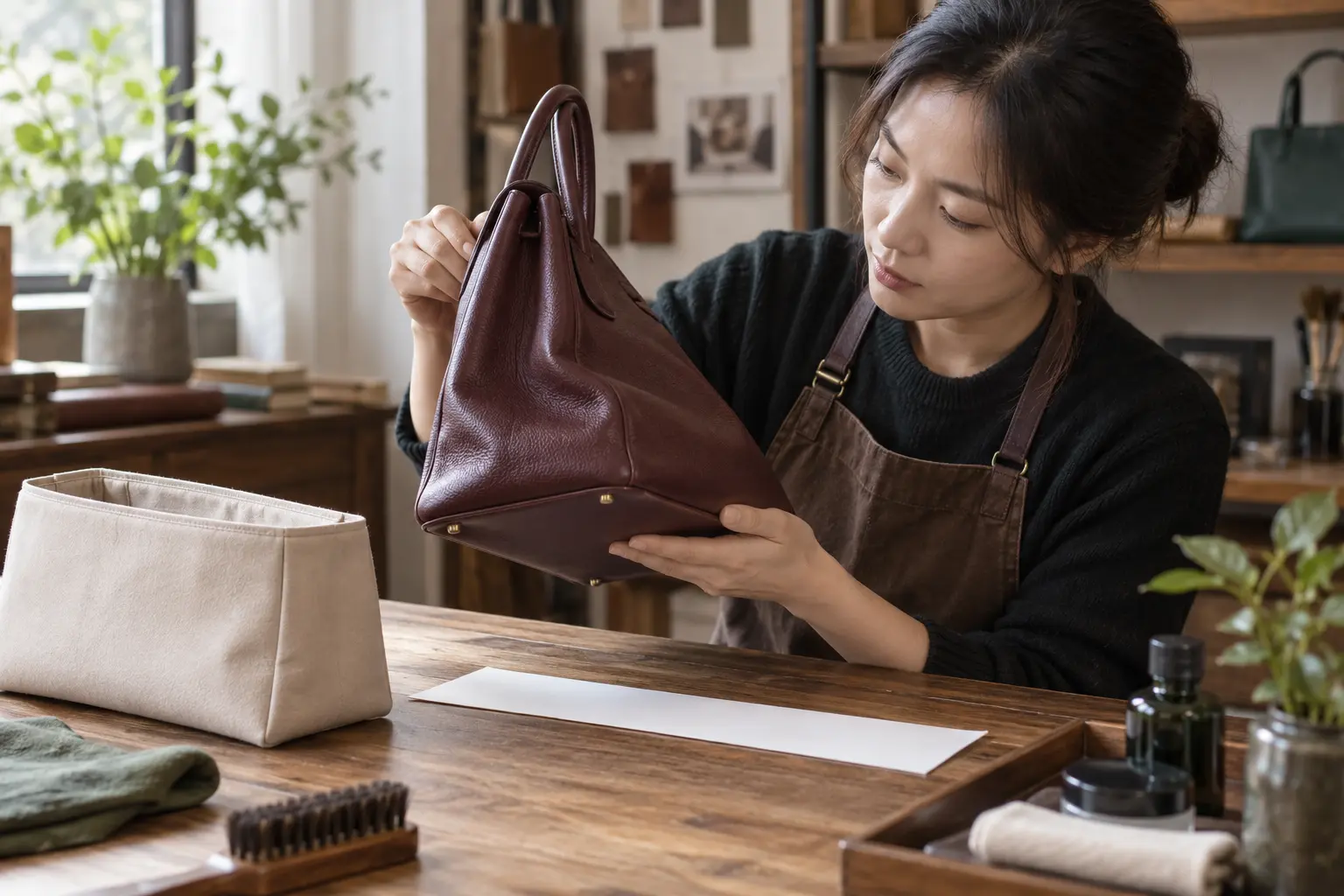
Temporary compression, long-term relaxation and structural damage need different responses. Stuffing can help only mild, temporary distortion. Forcing leather, stiffeners, edges, the base, seams or bonded layers can move stress elsewhere.
Inspect the empty bag
Remove its contents and assess shape and load-bearing areas. Stop if folds whiten, a stiffener appears cracked, stitching pulls or internal cracking noises occur.
Photograph the empty front, back and both sides; the opening from above for symmetry; the base for level and warping; creases in side light; and handles, strap attachments, seams and piping close up. Record whether it stands naturally on a level table.
Three levels of distortion
- Temporary compression: transport-related flattening with some natural recovery, no whitening or cracks and continuous structure. Gentle support and observation may help.
- Long-term sagging: the shape has relaxed without an obvious break. Restore appropriate support, aiming for stability rather than a new-bag promise.
- Structural damage: a permanent fold, broken board or piping, unusual noises, strained stitches or delamination requires repair assessment.
For mild compression
- Empty the bag and let it rest for several hours at room temperature in the shade.
- Use small rolls of white paper or clean cloth to support the base and corners.
- Fill only to its natural shape, without pushing against zips or stitches. Separate hardware with a soft barrier.
- Photograph it every 24 hours. If there is no improvement after three to seven days, or a new crease appears, stop increasing support.
Do not steam, heat or press heavily in the opposite direction. Heat and moisture can alter leather, adhesives, stiffeners and edge paint. Temporary softening may lead to new colour, gloss or bonding problems, or turn one crease into two.
Workshop assessment
Record the empty baseline, crease lines, loading and asymmetry. Check whether internal and external layers have distorted together and ask about storage and overloading. Explain the achievable improvement, permanent creases and aftercare. Compare photographs from the same angles and state whether filling is present.
Stop if there is whitening, brittle patent leather, a warped or apparently broken base, enlarged stitching holes, or sounds suggesting internal cracking or separation.
Common questions
Can I hang it to restore the shape? Avoid leaving its weight hanging from handles.
How do I judge the result? Remove the support and check that the empty shape remains stable without new creases. Assess structural continuity and stability over several days, not just its appearance while stuffed.