
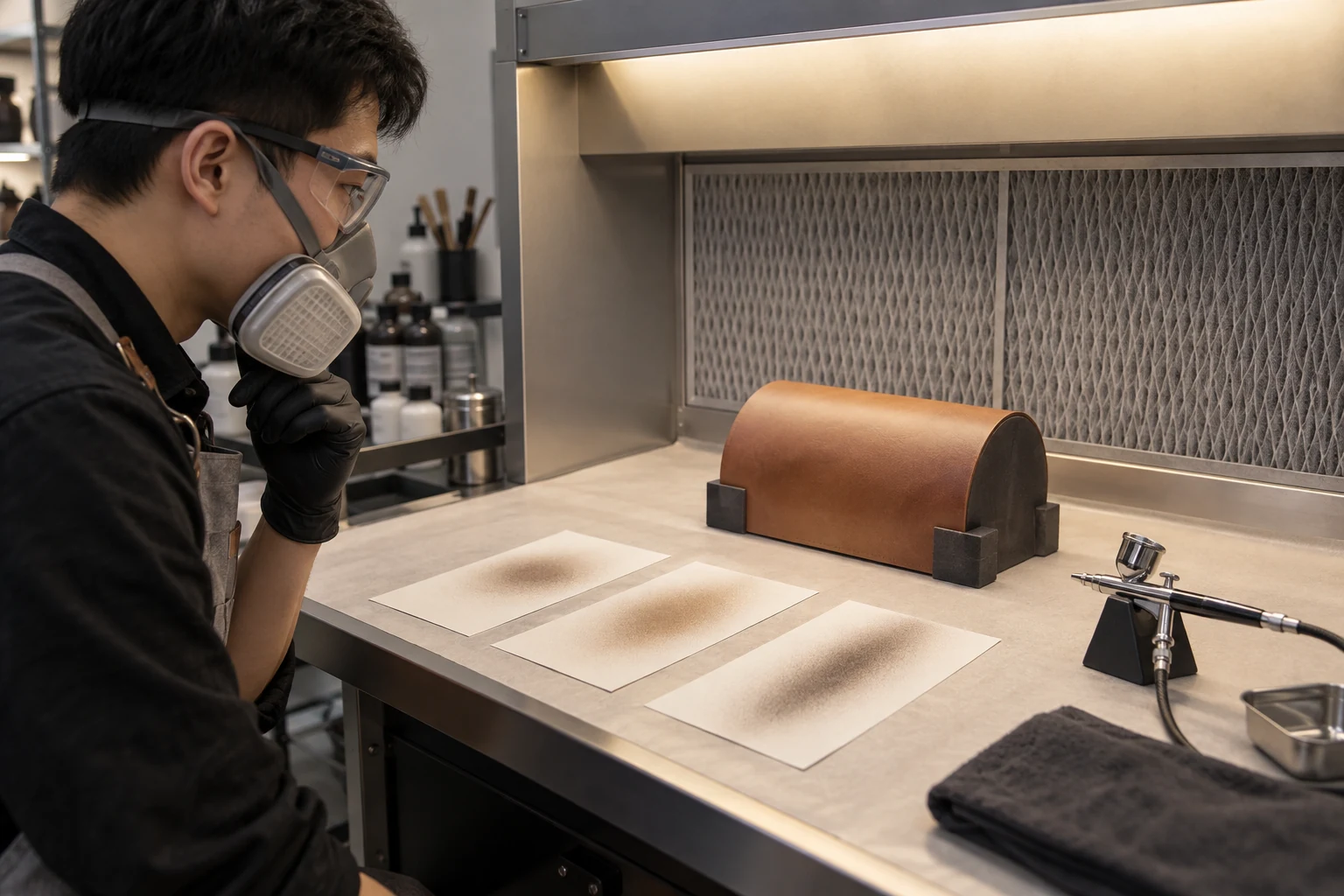
Adding more spray to poor coverage, then more to uneven colour, may hide the colour difference while burying grain and building up at corners. Atomisation, product condition, delivery and movement need to work together.
This learning approach assumes suitable equipment, ventilation and protection. Water-based materials still create spray exposure. Follow product safety information, equipment instructions and workplace requirements; there is no universal pressure, distance or dilution ratio across systems.
Describe the defect precisely
Coarse dry particles, alternating light and dark bands and liquid runs are different problems. Photograph the test and note details such as dry edges, dark overlaps or a dot at the start of a pass. If delivery is intermittent, check preparation, nozzle and air supply before blaming hand control.
Change one variable
- Check the needle, nozzle, air supply and cleanliness as instructed. Depressurise and disconnect power as required before dismantling.
- With compatible material, examine the basic pattern on a test medium. Do not change colour, gun, pressure and dilution together.
- Keep material and settings fixed while practising even speed and distance. Start and finish passes beyond the sample and inspect start-stop build-up.
- Keep technique fixed while changing one setting within the equipment and product recommendations. Retain results for comparison.
- Move to practice leather resembling the target and assess adhesion, texture and the complete finish. A good pattern on paper proves only part of the process.
Practise corners separately
At a corner the hand often slows, distance shortens and angle changes. Unchanged delivery can then deposit too much. Wrap scrap leather around a rounded support and practise passing the curve without seeking full coverage at once. If the flat panel is even but the corner dark and shiny, check pauses and distance before changing the material. Darkening the whole bag only spreads the problem.
Stop and investigate
Do not repeatedly spray a wet run or bury roughness under endless layers. Follow the system's permitted correction and waiting stages, then diagnose on a sample. Wrinkling, tackiness or delamination calls for compatibility assessment rather than further gun adjustment.
Record the system, equipment model and settings, base condition, movement, environment and defect location. Someone else's precise numbers are not automatically your standard.
Consistent flat samples, clean rounded transitions, and suitable adhesion and flexibility checks after curing indicate progress. You should also be able to identify the first variable to investigate in a failed sample.
Study REBIRTH's spray-gun and airbrush lessons alongside smooth-leather restoration to understand both equipment and its place in the process. Without an appropriate spraying space, begin with observation and sample analysis and arrange supervised practical learning in a suitable setting.
Use four record columns: defect, unchanged conditions, the single adjustment and result. If speed improves banding, retain it for confirmation; changing both gun and material cannot reveal which change helped.